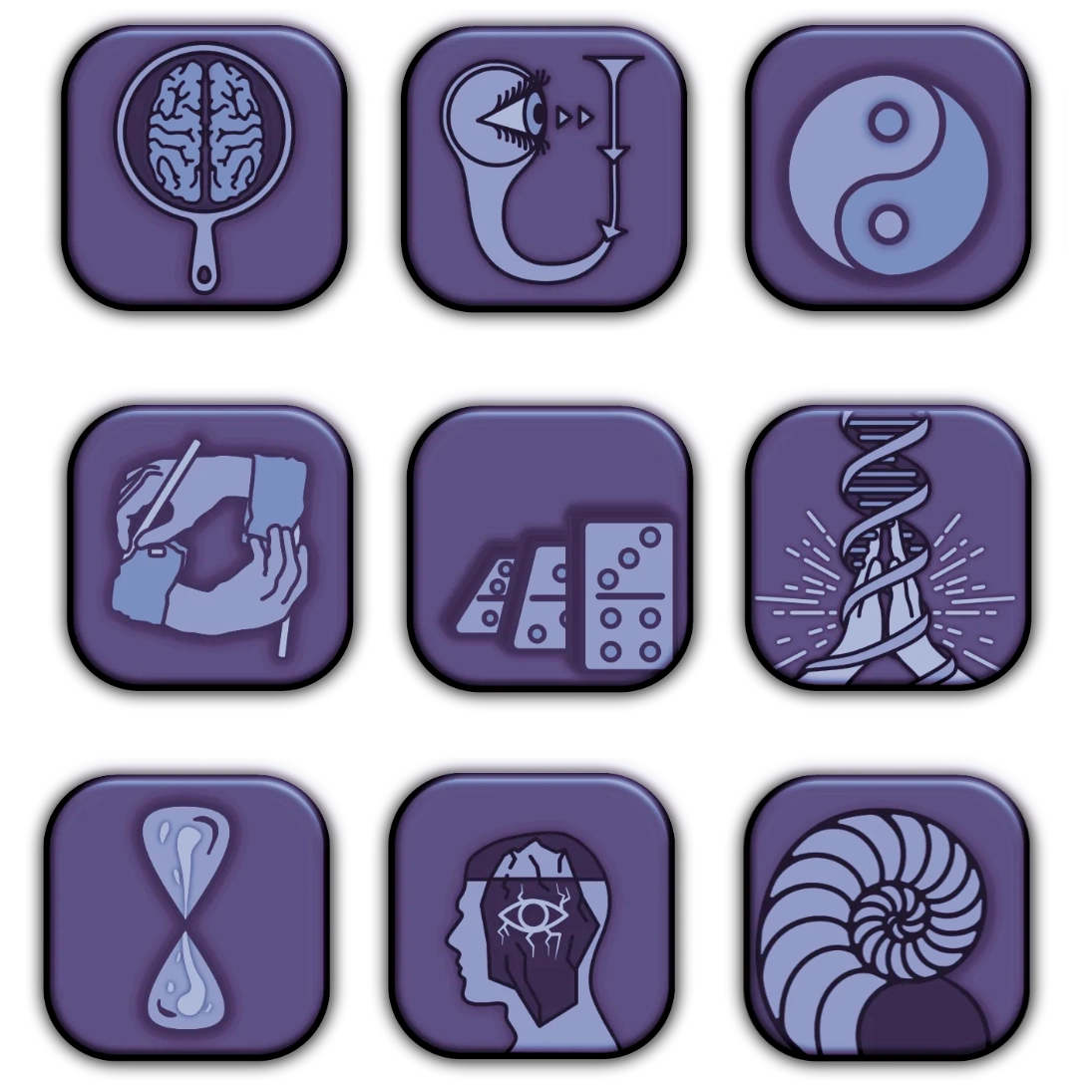
What is McKenna Syndrome?
Named for the ethnobotanist and psychonaut Terence McKenna, McKenna Syndrome is a persistent condition characterized by compulsive metaphysical framework formulation and an overwhelming drive to share profound insights following prolonged psychedelic use.
The condition is theorized to result from chronic over-activation of the brain's neurological spirituality drive. While milder presentations may be channeled into creative or philosophical pursuits, more severe cases can lead to significant social and occupational impairment.
The following diagnostic criteria are described in my DSM 5-TR fanfiction.
DIAGNOSTIC CRITERIA
Criterion A
Two (or more) of the following symptoms, each present for a significant portion of time during a period of at least one month, developing during or shortly after a period of prolonged and regular psychedelic use:
Compulsion to Contextualize
A persistent compulsion to construct comprehensive metaphysical, spiritual, or cosmological frameworks within which to contextualize one's life and experiences, up to and including complete theories of everything.
Conviction in Beliefs
An unshakeable conviction that these frameworks are true and self-evident, accompanied by a tendency to regard insights obtained in altered states as inherently more valid than conclusions reached through sober evaluation of the same material.
Socially Inappropriate Evangelism
A compelling urge to communicate these ideas and frameworks to others that persists regardless of social context or the receptiveness of the audience.
Insight Inflation
A marked reduction in the threshold at which ideas are experienced as profound, such that commonplace thoughts and observations acquire a felt sense of revelation.
Framework Instability
Serial adoption and replacement of totalizing worldviews (e.g., simulation theory, panpsychism, nondual idealism), each held with full conviction for the duration of its tenure.
Criterion B
The symptoms cause clinically significant distress or impairment in social, occupational, or other important areas of functioning.
Criterion C
The symptoms persist well beyond the expected duration of acute intoxication, are not attributable to the ongoing physiological effects of a substance, and are not better accounted for by another medical condition.
Criterion D
The disturbance is not better explained by a schizophrenia spectrum or other psychotic disorder, including delusional disorder, and does not occur exclusively during the course of such a condition.
Severity Specifiers
Mild
Few, if any, symptoms in excess of those required to meet the diagnostic threshold. Symptoms manifest primarily as heightened philosophical preoccupation and creative output, with minor functional impairment.
Moderate
Symptoms result in notable social or occupational impairment, with increasing difficulty distinguishing insight from ideation.
Severe
Pervasive detachment from consensus reality, with marked impairment across multiple domains of functioning. Insight into the condition may be substantially diminished.
Associated Features
Commonly co-occurring features include heightened interest in fractal geometry and sacred or archetypal patterns; reports of contact with autonomous entities during acute intoxication; distorted temporal perception, including eternalism and the subjective experience of time loops; elevated pattern recognition extending to apophenia; preoccupation with synchronicity; a sense of communicative urgency, in which insights are experienced as perishable unless immediately shared; and increased susceptibility to guru–follower dynamics. Solipsistic and panpsychist ideation are frequently observed.
DIFFERENTIAL DIAGNOSIS
Schizophrenia Spectrum and Other Psychotic Disorders
In McKenna Syndrome, insight remains at least partially intact: when directly prompted, the individual can typically entertain the possibility that their frameworks overreach. Beliefs take the form of shareable philosophical frameworks rather than self-referential or persecutory delusions, and functional decline proceeds gradually through preoccupation rather than acutely through disorganization.
Substance/Medication-Induced Psychotic Disorder
In substance-induced psychotic disorder, hallucinations and delusions are directly attributable to the physiological effects of a substance and remit upon discontinuation. In McKenna Syndrome, symptoms persist through extended periods of abstinence and are organized around belief formation rather than perceptual disturbance.
Delusional Disorder
Delusional disorder is characterized by fixed, typically self-referential beliefs that resist revision. The frameworks characteristic of McKenna Syndrome are, by contrast, enthusiastically and serially revised, with the individual generally experiencing revision as intellectual progress rather than threat.
Prevalence & Demographics
Prevalence estimates are not available; the condition is believed to be substantially underreported, as affected individuals rarely self-identify as impaired. Onset predominantly occurs in adulthood, consistent with the demographics of psychedelic use. Elevated risk is observed among individuals with limited prior exposure to epistemic frameworks for evaluating subjective experience, and among those with pre-existing tendencies toward magical thinking or pattern over-attribution. The condition should be distinguished from nonpathological spiritual development, in which comparable experiences are integrated without compulsion, fixed conviction, or functional impairment; Criterion B is determinative.
Etiology
Neurological Drive
Human beings possess an inherent neurological spirituality drive that compels them to contextualize their life within a larger framework.
Psychedelic Activation
Psychedelics stimulate this drive. Excessive and prolonged use can overstimulate it beyond baseline levels.
Critical Mass
With sufficient cumulative stimulation, the drive fails to return to baseline between exposures, entering a self-reinforcing state in which each insight generates demand for further insight.
Management
Moderate Use
Take a prolonged break to allow the drive to reset.
Social Discretion
Learn to hide your power level. Evaluate the appropriateness of social situations before discussing profound insights.
Creative Channeling
Direct compulsion into art rather than evangelism.
Critical Analysis
Challenge your belief systems from a rational standpoint.
Study Epistemology
Explore literature on navigating unusual mental states.
dsm.psychiatryonline.org
Foundation